
The Riveting Story of Joe and the Shovel
There is a thought that I always come back to, and now I’ll honor that thought properly and give it an article. It goes like this: Most, if not all, of our problems in the corporate world could be solved if we talked to each other honestly.
How offensively simple does that sound, right? Given the amount of money we spend on consulting, transformation and the like, I tremble a bit writing it down. But I’m gonna put my big girl pants on and ask you to humor me.
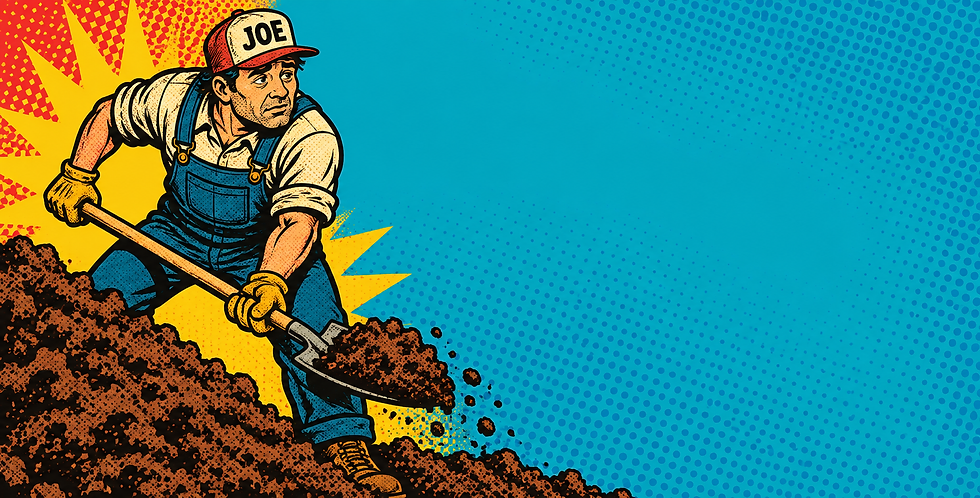
Allow me to introduce you to Joe, the Dirt and the Shovel
So imagine we have an organization where the main objective is to shovel as much dirt as possible. Let’s assume, for some reason, it’s a highly lucrative endeavor. So we hire Joe to do the shoveling while we are planning our grand strategies for market dominion.
Then one day we realize… Joe is not particularly effective lately. The market has also changed, shareholders are worried, we panic. So what do we do?
We announce a strategic and mindset shift, establish a project team and call it “Dirt, but out of the box.” Then the project team starts looking at process documentation, observes Joe from behind a foggy window 500 meters in the distance, gathers benchmark data, asks someone from McKinsey, prompts AI for “effective dirt shoveling strategies” and concludes that Joe needs to do his shoveling with a new double-headed shovel, 200 meters to the right and using only his left leg.
Then implementation starts.
By the time it reaches Joe, seven steps removed from where the decision was made, the shovel is the same, the direction is 10 meters to the left, and he is supposed to jump on the shovel with both legs.
Then we don’t see improvement, so we put Joe on a performance improvement plan and start addressing his “resistance to change.”
Now imagine this slightly exaggerated scenario differently. And hold on to your chair because this is going to be radical.
Meeting Joe
What if we start by walking down to Joe and ask:
“Hey Joe, what’s up with the shoveling?”
Maybe Joe would have told us that the handle gives him splinters all the time, or that the head of the shovel bends every time he pushes it into the ground, or that actually there is concrete underneath, or that his wife is sick and he is preoccupied, or that his shoes are too thin-soled and it hurts him to shovel… Or whatever else you can imagine.
If we routinely check in with Joe, we don’t need to make decisions based only on the latest trends. We can make them based on actual intel coming from a person in touch with shoveling reality.
Because each of Joe’s problems requires a different solution, and observation from afar, even when supported by data related to Joe’s shoveling, may never reveal which problem we actually have.
We can conclude with fair confidence that proximity to the work produces information that abstraction cannot.
Is Joe dangerous?
So let’s examine this. Why didn’t we talk to Joe in the first place?
Well, if you’ve spent as much time as I have inside organizations, you will know perfectly well that various things need to be present simultaneously, both for Joe to speak up and for the questioner to listen. Safety. Truth tolerance. Curiosity. Humility. The ability to tolerate feeling threatened. Not being intimidated into silence by hierarchy. And I can keep going, but what for? You probably already feel this in your guts.
But this line of reasoning gives my mind no satisfactory place to land.
So my next question is going to be about abstraction:
Wait, why are we doing all this other shit in the first place?
If the organization exists to shovel dirt, shouldn’t it be obsessively interested in Dirt, Shovels and Joes?
Because if that were true, everything else should exist in service of these three things.
Finance? Shoveling needs resources, Joes need to be paid, and the whole thing cannot go to shit for tax evasion.
HR? All Joes are human, so yeah, they definitely should be occupied with all the Joes in the organization.
IT? Absolutely. Tools enable shoveling.
Strategy? Hell yes. Someone needs to decide which dirt is worth moving.
Management? I’m hesitant here, but let’s say Joes and shovels need some coordination at scale.
And what about profit?
Profit matters. Obviously. But profit is not the activity the organization exists to perform. It is a measure produced by the activity, telling us something rather important about whether this whole dirt-moving endeavor is economically viable.
You clearly cannot shovel EBITDA.
This all makes sense, but somewhere along the way, the support structures stopped being supportive and they became THE THING.
Joe is no longer the thing
We are no longer optimizing for Dirt or Shovels or Joes. Now we’re optimizing KPIs, governance, investor narratives, budgets, careers, organizational territory, transformation programs, reporting structures and quarterly growth.
We built abstractions to help us manage the work.
Then we began managing the abstractions.
Eventually, we forgot there was work underneath them.
Assuming people genuinely want dirt moved, becoming extraordinarily good at dirt, shovels and Joes should enable economic value to follow. Profit matters. But profit creation is not the activity the organization exists to perform.
And this creates other dangers when it goes unchecked and there is no mechanism in the organization that ties everything back to Dirt, Shovels and Joes.
One of those dangers is obsession with Growth. Once profit stops being feedback about the dirt-moving system and becomes the primary object of optimization, growth follows almost automatically as an organizational imperative.
If last year we shoveled 10 million tonnes of dirt, then this year it has to be 11 million and next year it has to be 13 million…
While Joe is scratching his head thinking:
“Does anyone actually need 13 million tonnes of dirt moved?”
And the system shuts Joe up quite quickly, because apparently the right question is:
“How do we deliver on the 8% growth we promised?”
And with that, we have fascinatingly moved away from organizations serving an external need toward organizations whose continuous expansion becomes a goal in itself.
The means becomes the end.
And the greater the distance between what the organization optimizes and the work through which it actually creates value, the easier it becomes to improve the former while degrading the latter.
The KPI can improve while shoveling gets worse.
Joe and joe's bosses are frozen for the same reason
Let’s keep moving further down the rabbit hole, because you know what?
Once status, compensation, careers and identity attach themselves to abstractions, accurately describing the shovel becomes politically consequential.
The shovel can’t simply be bent anymore.
Someone approved that shovel.
Someone selected it. Someone funded it. Someone presented it. Someone’s KPI may depend on its successful adoption. Someone may have stood in front of a room full of senior leaders and announced that this particular shovel represents the future of dirt.
So saying, “Oops, sorry, wrong shovel. Let’s test which kind would actually be fit for purpose,” suddenly costs a lot of face.
“The shovel bends” is no longer merely information.
It has consequences.
And if only it stopped there.
Because distance from the work doesn’t only corrupt what decision-makers know. It also changes what Joe is allowed to do.
Joe is not disengaged
Joe probably broke his shovel at one point and started looking around for the shed with backup shovels, only to be told:
“No, Joe, we don’t trust you to get your own tools. Please submit a ticket and request a new shovel, but continue delivering against your shovel productivity target while awaiting approval.”
And Joe was thinking…
Wait, what?
You see, Joe probably heard that the organization expects ownership from people. And then the organization blames people when they won’t demonstrate ownership.
Meanwhile, the ability to act has been systematically and often invisibly removed from them.
So Joe is standing there and knows there are twelve shovels in that shed. Joe can see them. The ticket dude can see them. They all know Joe needs a shovel. We have now spent more money operating the Shovel Request Governance Process than the shovel costs. And Joe is either thinking WHY ARE WE DOING THIS? Or Joe shrugs and thinks “If that’s how you wanna play it, fine by me. I can sit around or build dirt castles, and I’ll still get my salary.” And god forbid we ever reflect on just how carefully the system trained Joe to shrug or burn out.
And the show goes on, regardless of what it costs Joe to experience the loss of his agency. Joe knows perfectly well that he will think twice before taking action again, because he has learned that it’s not safe and that the rules are contradictory at best. So Joe has to shovel and simultaneously maintain awareness of and navigate the absurd system surrounding the shoveling, while someone in HR is sweating because Joe is not engaged.
Leadership loses information upward.
Joe loses agency downward.
And again, we keep getting worse at what we are actually doing.
Surprise. Somehow, the people farthest away from the shovel often acquire the greatest authority over how the shovel should be used and occasionally also about how Joe the ungrateful should feel about it.
All of this creates an enormous abstraction layer between decision-makers and Dirt, Shovels and Joes.
AI KNOWS AN AWFUL LOT ABOUT JOE
And guess what technology is extraordinarily good at manipulating abstractions?
Well, hello and welcome to the circus, AI.
A fascinating technology that could actually be super freaking useful in understanding Dirt, Shovels and Joes better.
But no. That would apparently be way too inelegant.
Instead, we seem particularly fascinated with applying it to the representation of work: summarizing meetings about Joe, productivity analysis about Joe, shovel dashboards, shovel strategy, shovel transformation communications, performance goals, sentiment analysis, executive summaries, AI maturity assessments…
Need I go on?
There is nothing inherently wrong with this. Representation is necessary at scale.
But organizations already suffering from abstraction may be especially attracted to AI applications that make abstraction cheaper, faster and more convincing.
And while doing so, AI can make more distance feel like proximity.
And that, people, is a whole new can of worms.
AI can produce an extraordinarily sophisticated explanation of Joe from thousands of data points.
And therefore:
We can experience the sensation of understanding Joe without encountering Joe.
AI didn’t create the foggy window.
It may give us such an extraordinarily high-definition view through it that we forget there is glass.
And eventually we may not even think:
“Hey, why don’t we ask Joe?”
We will feel like we don’t need to.
And if you’ve read anything from me, you know I’m not at all anti-AI. And I’m fully aware that AI is already doing extraordinary things much closer to actual work, too.
But I do think we are at serious risk of using it wrong.
AI should tell us where to look, not convince us that we’ve already looked.
If we use AI to understand our Dirt, Shovel, Joe trifecta so that we can ask better questions and investigate reality based on what we find, then yes, AI can absolutely help an organization thrive.
But if we feed it data about reality, receive a convincing interpretation and then mistake that interpretation for reality itself…
Well, I’m none too optimistic.
Yes, AI can detect patterns humans cannot see at scale.
Brilliant.
But then somebody still needs to walk down to Joe.
Joe is the key to reality
So maybe the final organizational test becomes absurdly simple:
What does this have to do with Dirt, Shovels or Joes?
New initiative? New governance structure? AI transformation? Reorganization? New KPI?
Always ask:
What does this have to do with Dirt, Shovels or Joes?
If nobody can trace the thing back to the actual work, perhaps you’ve discovered something worth examining.
Maybe our problems aren’t solvable simply by getting humans to talk to each other.
But maybe talking to each other is how organizations maintain contact with reality.
And maintaining contact with reality becomes very, very difficult once you’ve built enough incentives, abstractions, identities and hierarchies around yourself that reality itself has become threatening.
So the next time everyone has analyzed the 17% decline in shovel productivity, the transformation was launched, AI was deployed, consultants were paid, and Joe’s resistance was managed, I hope when we walk to Joe and ask “Hey Joe, what’s up with the shoveling?” Joe will not look at the enormous empty field and reply: “We ran out of dirt three months ago”
Comments